


Why Your Gaming PC Choice Matters for Competitive Play
An Esports gaming computer is a high-performance system built for one purpose: competitive victory. It prioritizes consistent high frame rates, low input latency, and stability over sheer graphical fidelity.
Key Requirements for Esports Gaming Computers:
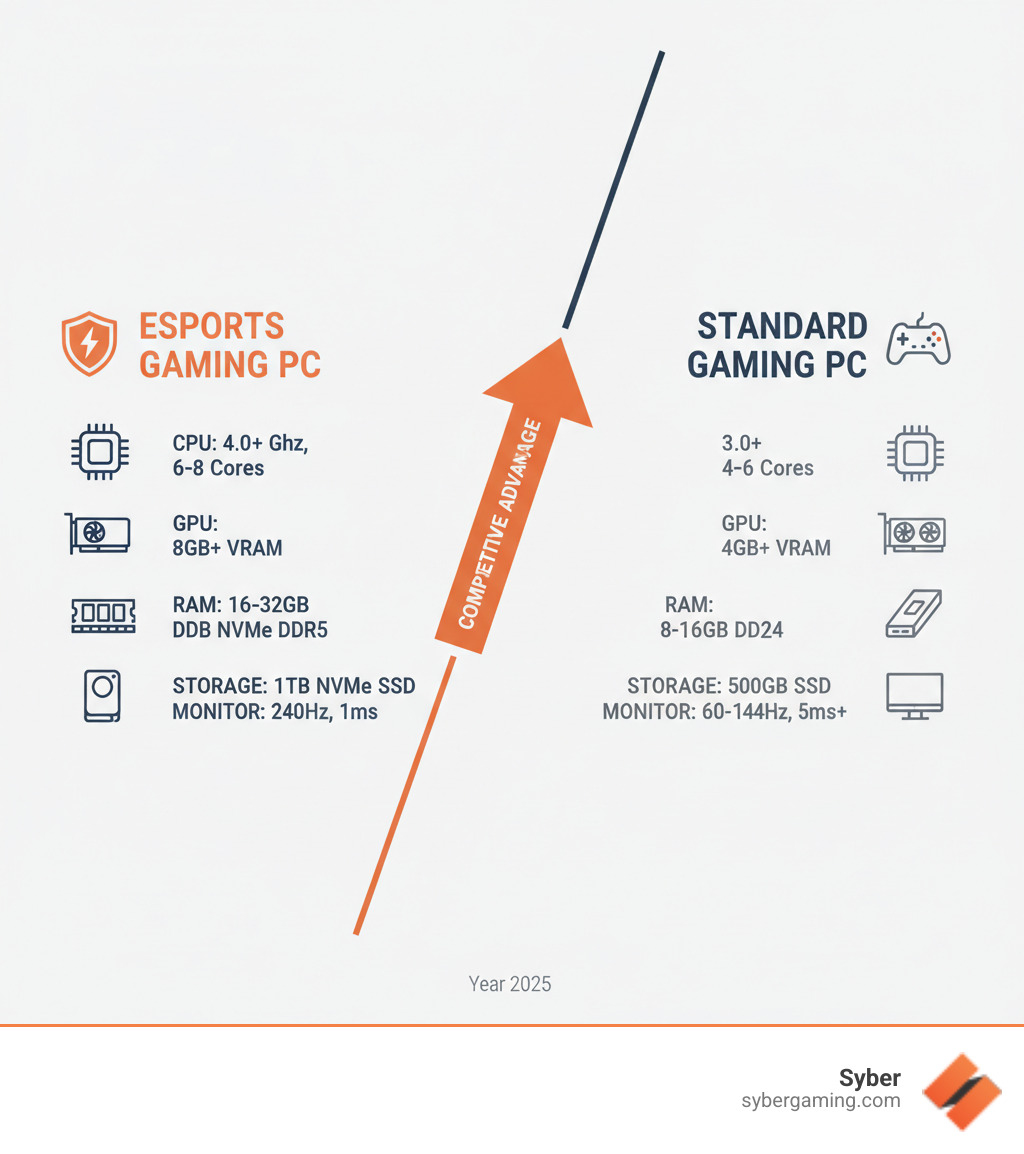
- CPU: High clock speeds (4.0 GHz+) with 6+ cores (8+ for streaming).
- GPU: NVIDIA RTX 40/50 series or AMD RX 6000/7000 series with 8GB+ VRAM.
- RAM: 16GB minimum DDR5, 32GB for streaming.
- Storage: 1TB NVMe SSD (PCIe Gen 4) for fast load times.
- Monitor: 144Hz minimum refresh rate, 240Hz+ recommended with 1ms response time.
In esports, milliseconds matter. Unlike standard PCs built for visual spectacle, an esports rig must deliver unwavering performance during critical tournament moments. Professional players invest in top-tier systems because a fraction of a second can determine the outcome of a match.
Most esports titles favor single-threaded CPU performance, making high-frequency processors essential. The GPU's job is raw FPS output, not fancy ray tracing. This is why mid-tier cards like the RTX 4060 or AMD RX 7600 excel—they provide the necessary frame rates without costly extras.
Whether you're climbing ranked ladders or competing in tournaments, your hardware directly impacts your competitive edge. The right esports gaming computer removes performance barriers, letting you focus on strategy.
Building Your Ultimate Esports Gaming Computer
Building an Esports gaming computer is about making smart choices that prioritize raw performance, stability, and lightning-fast responsiveness. Every component needs to work together seamlessly to give you a competitive edge.
The Power Core: CPU, GPU, and AI-Improved Gaming
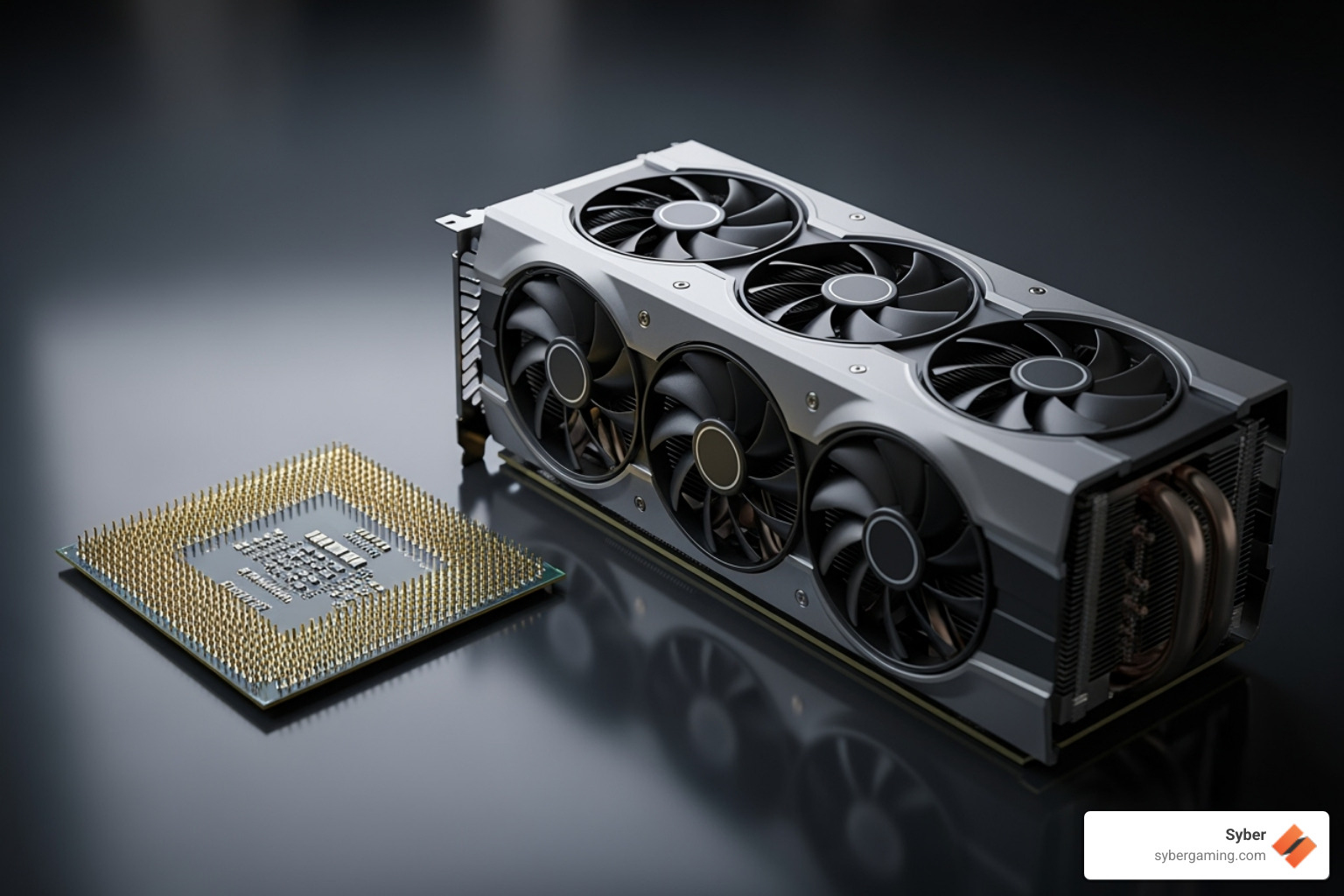
The heart of any Esports gaming computer is its CPU and GPU. For the CPU, single-threaded performance is king. Esports titles like Valorant and CS:GO depend on high clock speeds (4.0 GHz+) more than core count. An Intel Core i5/i7 or AMD Ryzen 5/7 is ideal, though streamers should opt for 8+ cores to handle the extra load.
The GPU is your frame rate engine. In esports, the goal is maximum FPS for fluid gameplay, not photorealistic graphics. A custom build gaming pcs approach lets you prioritize this. Modern cards like the NVIDIA RTX 40 series or AMD RX 6000/7000 series with 8GB+ of VRAM are perfect. The RTX 4060 or RX 7600 are strong choices, delivering high frame rates without unnecessary features.
AI gaming technology offers a further edge. NVIDIA's RTX 40-series cards use AI graphics rendering like DLSS to boost frame rates significantly, providing sharper images without a performance hit. This AI-improved gaming tech is essential for pushing performance boundaries.
Stability and Speed: RAM, Storage, and Cooling
Consistent performance relies on more than just the CPU and GPU.
RAM: For most esports builds, 16GB of DDR5 RAM is the sweet spot to prevent stuttering. If you plan to stream, upgrade to 32GB for smooth multitasking and future-proofing.
Storage: Don't get left on the loading screen. An NVMe SSD with at least 1TB of storage (PCIe Gen 4) provides near-instant boot and game load times, giving you a real advantage.
Cooling: Overheating causes performance throttling, which can cost you a match. A Syber M-Series high performance gaming pc build showcases how crucial proper airflow is. An efficient cooling system ensures your components maintain peak performance, even during intense, marathon sessions. Emerging AI cooling solutions even offer dynamic adjustments for optimal thermal management.

Essential Peripherals for Your Esports Gaming Computer
Your PC is only part of the equation. The right peripherals are the direct link between your reflexes and in-game actions.
- Monitor: A high refresh rate monitor (240Hz+) with a 1ms response time is non-negotiable. It eliminates motion blur and reduces input lag, letting you see and react faster.
- Keyboard: A mechanical keyboard offers faster actuation and tactile feedback. Anti-ghosting ensures every command registers during complex maneuvers.
- Mouse: A lightweight, ergonomic mouse with a high polling rate (1000Hz) minimizes delay between your movement and the on-screen response.
- Headset: Clear communication wins games. A quality headset with a noise-canceling mic and spatial audio helps you pinpoint enemy locations and coordinate with your team.
To Build or To Buy: Pre-Built vs. Custom PCs
You have two main paths: build it yourself or buy a pre-built system.
A high performance custom prebuilt gaming pc from Syber gets you in the game faster. These systems are assembled, tested, and benchmarked for perfect compatibility and performance right out of the box. A gaming pc pre built also comes with a warranty and support, offering peace of mind. The Syber Cube series offers great pre built gaming pc customizable options, letting you pick key components without the hassle of building.
To build high performance gaming pc yourself offers total control and a deep understanding of your machine, but it requires time, research, and troubleshooting.
Syber combines the best of both worlds, offering expertly assembled and tested systems you can customize. The goal is always to deliver a gaming pc high performance machine for your competitive needs. Explore options at https://www.sybergaming.com/cubeseries.
Maximizing Performance and Longevity
Getting your hands on an Esports gaming computer is just the beginning. Smart budgeting, future-planning, and regular maintenance will keep your system running at peak performance for years to come.
Budgeting for Your Esports Gaming Computer
Your budget determines your build, but you don't need to break the bank to compete.
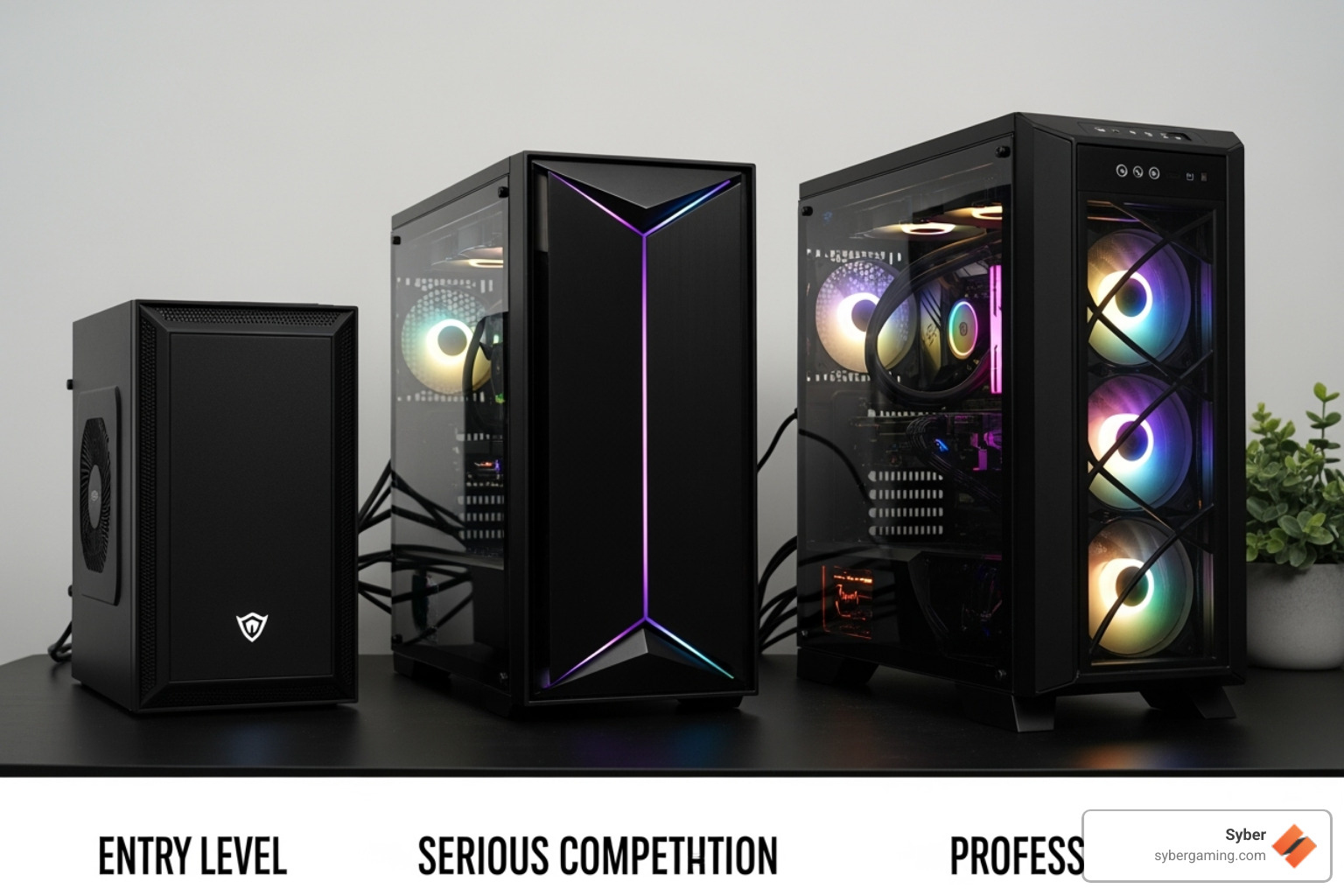
- Entry-Level ($1,000 - $1,500): This range gets you in the game with a solid mid-range CPU (Core i5/Ryzen 5), a capable GPU (RTX 4060/RX 7600), 16GB of RAM, and an SSD. It's perfect for hitting 144Hz+ at 1080p in popular esports titles.
- Serious Competitor ($1,500 - $2,500): This is the sweet spot for players aiming for consistent high performance in FPS games. Expect a stronger CPU (Core i7/Ryzen 7), a higher-tier GPU (RTX 4070 Super/RX 7800 XT), and 32GB of RAM. This tier targets 240Hz+ at 1080p and solid 1440p gaming.
- Professional-Grade ($2,500+): Built for dominance, these high performance custom prebuilt gaming pc options feature top-tier components (Core i9/Ryzen 9, RTX 4080 Super/RX 7900 XTX) to eliminate every bottleneck for pro players and streamers.
Remember to prioritize components based on your favorite games. FPS players should focus on the GPU and monitor, while MOBA/RTS players benefit more from a powerful CPU.
Future-Proofing and Maintaining Your Rig
An Esports gaming computer is an investment. Smart planning and regular maintenance will keep you competitive for years.
Future-Proofing Your Build:
- Motherboard: Choose a modern platform that supports DDR5 and has room for future CPU and storage upgrades.
- Power Supply (PSU): Select a PSU with more wattage than you currently need to accommodate future, more powerful components.
- AI Technology: Invest in components with AI gaming technology. GPUs with AI-powered graphics and features like DLSS will stay relevant as games evolve and rely more on AI system optimization.
Essential Maintenance:
- Cleaning: Dust kills performance. Regularly clean dust filters and use compressed air on fans and heatsinks every few months.
- Driver Updates: Keep your GPU and motherboard drivers updated for the latest performance improvements and bug fixes.
- Thermal Paste: Consider reapplying thermal paste to your CPU/GPU every couple of years to maintain optimal heat transfer.
A well-maintained high performance desktop pc doesn't just last; it thrives. With smart planning and care, your system will deliver the edge you need to dominate. For high-performance options that combine cutting-edge AI gaming performance with reliability, visit Syber's gaming PC selection.
Ready to level up your esports experience? Explore Syber's high performance gaming PCs at https://www.sybergaming.com/.
_compressed.png)

.svg)

